Beyond Government Grants: Alternative Funding Sources Every Business Should Know
Beyond Government Grants: Alternative Funding Sources Every Business Should Know

For lots of Australian businesses, business grants are the first funding option that comes to mind when planning expansion, launching new products, or investing in innovation. While government grants remain an excellent source of capital, they are highly competitive, often industry-specific, and usually require businesses to meet strict eligibility criteria.
The good news is that grants are only one piece of the funding puzzle. Today, businesses have access to a wide range of alternative business funding solutions that can provide the capital needed to scale, innovate, and remain competitive.
At Grants & Funding Partners, we help Australian businesses identify not only government grant opportunities but also the broader funding landscape, including corporate funding, investment capital, and philanthropic grants, ensuring businesses don't overlook valuable opportunities.
Why Businesses Should Look Beyond Government Grants
Government grants are designed to stimulate economic growth, innovation, sustainability, regional development, and job creation. However, not every business project will qualify.
Common challenges include:
- Limited application windows
- Competitive assessment processes
- Industry-specific eligibility
- Matching funding requirements
- Extensive documentation
Rather than waiting for the perfect grant to open, successful businesses build funding strategies using multiple capital sources.
Diversifying your funding reduces financial risk and increases your ability to seize growth opportunities when they arise.
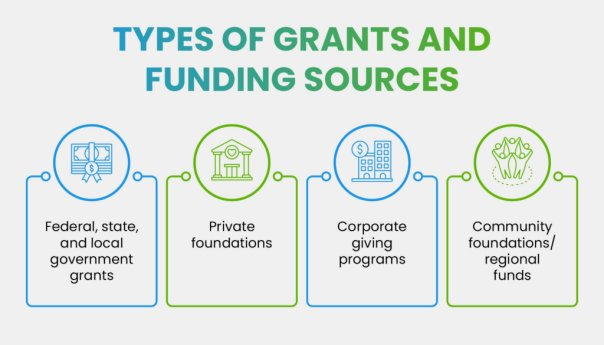
1. Government Business Grants
Government funding remains one of the most attractive forms of finance because successful applicants generally do not repay the money.
Australian governments offer thousands of grant programs supporting areas including:
- Manufacturing
- Export development
- Renewable energy
- Tourism
- Agriculture
- Digital transformation
- Research and development
- Regional growth
With more than 2,700 grant programs available across Australia, identifying the right opportunity requires specialist knowledge and strategic planning.
Professional grant consultants can significantly improve success rates by matching projects to suitable funding programs and preparing competitive applications.
2. Government sponsored special investment vehicles
National Reconstruction Fund Corporation, is a $15 billion fund established to transform and diversify Australian industry.
- Focus areas: Value-add in resources and agriculture, transport, medical science, renewables, and defence capabilities.
- Financial tools: Debt (loans), equity investments, and loan guarantees.
- Key mechanism: It targets structural gaps to rebuild sovereign manufacturing and industrial capability.
Clean Energy Finance Corporation (CEFC)
The CEFC is a $10 billion government-owned "green bank" targeting clean energy and emissions reduction.
- Focus areas: Renewable energy technologies, low-emission solutions, and energy-efficient infrastructure.
- Financial tools: Commercial and concessional loans, asset finance, and co-investments in equity.
- Key mechanism: Partners with major commercial banks (like NAB) to deliver discounted "green" finance products for businesses, farmers, and household upgrades.
Future Made in Australia (FMA)
"Future Made in Australia" is a broad overarching policy framework rather than a standalone bank.
- Focus areas: Maximizing the economic and industrial benefits of the net-zero transformation and securing global leadership in green-powered industries.
- Financial tools/Mechanism: It coordinates public investments, directing agencies like the CEFC, NRF, and EFA to back strategic industries, domestic critical minerals processing, and renewable hydrogen.
Export Finance Australia (EFA)
EFA is Australia's official export credit agency, supporting international trade and overseas infrastructure.
- Focus areas: National interest projects, critical minerals, defence exports, and infrastructure development in Southeast Asia and the Pacific.
- Financial tools: Loans, bonds, guarantees, insurance, and selective equity participation.
- Key mechanism: Operates a Commercial Account for standard export risks alongside a National Interest Account where the government explicitly directs and backs strategic trade projects.
3. Philanthropic Grants
Many businesses overlook philanthropic grants, assuming they are only available for charities.
In reality, philanthropic foundations increasingly fund projects that deliver measurable social, environmental, educational, Indigenous, or community outcomes.
Businesses operating with social impact initiatives may qualify for funding through:
- Community foundations
- Corporate charitable trusts
- Family foundations
- Environmental foundations
- Social enterprise funds
Examples include projects involving:
- Sustainability
- Mental health
- Indigenous employment
- Regional development
- Education
- Community wellbeing
These grants often complement government funding, allowing organisations to combine multiple funding sources.
4. Equity Investment
Businesses with strong growth potential may attract equity investors.
Rather than lending money, investors purchase ownership in the business and share both the risks and rewards.
Common equity investors include:
- Angel investors
- Venture capital firms
- Private equity funds
- Strategic industry partners
This type of alternative business funding is particularly attractive for innovative companies developing scalable technologies or entering new markets.
While founders dilute ownership, they often gain valuable expertise, networks, and mentoring alongside capital.
5. Commercial Loans
Traditional business finance remains an important funding solution.
Banks and commercial lenders offer:
- Equipment finance
- Working capital loans
- Expansion finance
- Commercial property loans
- Trade finance
Unlike grants, loans require repayment with interest, but they provide immediate access to capital without giving up equity.
Businesses with strong cash flow and proven financial performance may secure competitive lending terms.
6. Crowdfunding
Crowdfunding has become an increasingly popular funding method for startups and growing businesses.
There are several models available:
- Reward-based crowdfunding
- Equity crowdfunding
- Donation-based funding
- Peer-to-peer lending
Beyond raising capital, crowdfunding validates market demand and builds customer engagement before products launch.
It can also generate significant publicity for innovative businesses.
7. Corporate Partnerships
Large corporations regularly fund smaller businesses through:
- Innovation partnerships
- Research collaborations
- Supply chain development
- Sustainability initiatives
- Industry acceleration programs
Corporate funding often includes:
- Direct financial support
- Pilot projects
- Product development
- Market access
- Technical expertise
These partnerships can create long-term commercial relationships that extend well beyond the initial funding.
8. Research and Development Incentives
Many innovative Australian businesses are eligible for research and development incentives that reduce the cost of innovation.
These programs reward businesses investing in:
- New technologies
- Product development
- Software
- Manufacturing improvements
- Scientific research
Combined with grants and private investment, R&D incentives can substantially reduce project costs.
9. Revenue-Based Finance
Revenue-based finance is becoming a popular option for businesses with recurring income.
Instead of fixed repayments, businesses repay investors using an agreed percentage of future revenue.
Benefits include:
- Flexible repayments
- No equity dilution
- Faster approvals
- Growth-focused funding
This model is particularly suited to subscription-based businesses and SaaS companies.
Building a Smarter Funding Strategy
Successful businesses rarely rely on one funding source alone.
Instead, they create a blended funding strategy that may include:
- Government grants
- Government loans and equity
- Philanthropic grants
- Commercial finance
- Private investment
- Tax incentives
- Corporate partnerships
- Revenue-based funding
Using multiple funding sources reduces dependence on any single program while increasing financial flexibility.
Experienced funding consultants can identify which opportunities best align with your business objectives and project readiness.
Why Expert Guidance Matters
The Australian funding landscape changes constantly, with new grant programs opening and closing throughout the year. Businesses that understand these changes are far better positioned to secure funding.
At Grants & Funding Partners, the team works with businesses across Australia to identify the best funding options for businesses, including government grants, private investment opportunities, corporate funding, and alternative business funding solutions tailored to each organisation's goals. Their services include strategic funding reviews, grant research, grant writing, and funding readiness assessments to maximise the likelihood of success.
Final Thoughts
Government grants remain an important funding tool, but they are only one part of the modern funding landscape. Businesses that explore alternative business funding, philanthropic grants, private investment, commercial finance, and other funding options for businesses often discover opportunities that better suit their growth objectives.
Whether you're launching a startup, expanding operations, commercialising innovation, or entering new markets, developing a comprehensive funding strategy can unlock opportunities that would otherwise remain out of reach.
Partnering with experienced funding specialists can help you navigate the increasingly complex funding environment, ensuring you pursue the opportunities that offer the greatest chance of success.